
A tearoom, a temple, a bowl of sea bream over rice, and handmade paper. Silence here is not an accident. It is designed
Six-hour itinerary:
09:45 Meet at Matsue New Urban Hotel by Lake Shinji
10:00 Kanden-an
12:30 Tai-meshi lunch at Minami
14:00 Gessho-ji
15:30 Abe Eishiro Memorial Hall
You will not understand Matsue by counting sights. The city’s aesthetic is organised around one sensibility: Fumai.
Fumai is the tea name adopted in retirement by Matsudaira Harusato, the seventh lord of the Matsue domain, later remembered as Lord Fumai. He is often introduced as a tea master, but that label is too small. He rebuilt governance, steadied the local economy, and raised culture and craft, using tea as the organising principle.
What visitors call quiet in Matsue is not simply the atmosphere or nature. It is the result of accumulated choices: what to keep, what to omit, and how to move through time.
That is why six hours is the right measure. It is short enough to feel concentrated, long enough to leave a trace.
One caveat: this route is difficult to execute by public transport alone. Matsue’s key places are scattered from the centre to the edges. To connect them into a single line, you need reliable wheels and tight timing. If your goal is to absorb the idea in your body rather than spend the day watching the clock, it is worth handing the logistics to a local operator.
Tokyo to Matsue: three ways
Assume a Tokyo departure and arrival around JR Matsue Station. Get yourself there, then let the tour car take over.
Fly and buy time
The cleanest option is a flight from Haneda to Izumo Enmusubi Airport, then the airport bus to Matsue. A second option is via Yonago Kitaro Airport, which also offers direct buses into the city.
Shinkansen and a limited express, buy the view
Take the Shinkansen to Okayama, then transfer to the Limited Express Yakumo for Matsue. The mountains deepen, the light flattens, and the transition does part of the work for you. It is slower than flying, but it gives you a gradual entry into the city’s tempo.
The overnight train changes the air
If there is one journey that matches Matsue’s logic, it is the sleeper train. The Sunrise Izumo leaves Tokyo at night and arrives in the morning. Timetables and fares change, so check before you travel.
Call it a practical choice if you like, but it functions as preparation. Sleep becomes a small ritual. You arrive reset, and the morning in Matsue has a clarity that suits Fumai’s world.
The six-hour sequence
Order matters. Fumai’s aesthetic is not primarily visual. It lives in gesture, touch, and the handling of time. With a tour car moving efficiently between sites, you can complete a full sensory course.
First, a tearoom that puts ma, the productive interval, into the body. Second, a meal whose flavour is completed by action. Third, a temple where time gathers in layers. Finally, paper, where the idea becomes texture.
09:45 Meet at Matsue New Urban Hotel by Lake Shinji
In Matsue, the first change is sonic. It is not that noise vanishes. It is that only the necessary sounds remain: water close by, footsteps, the dry clink of porcelain. The city’s quiet feels less like a gift and more like editing. Follow the editor’s hand, and you end up back at Fumai.
10:00 Kanden-an
Begin where Fumai’s thinking still exists as a plan you can enter. Kanden-an was built to his specifications in 1792 on the grounds of an Arisawa family villa and has been protected through the political changes that followed.
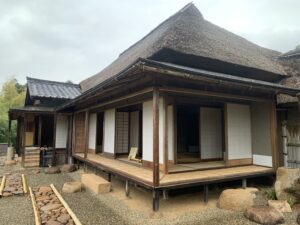
What you encounter here is not scenery. It is calibration. The low entrance reduces the body. Tatami lines reset the gaze. Speech thins out. The more you hunt for highlights, the less you see. The correct method is simpler: sit, wait, and listen for the sound of water coming to a boil.
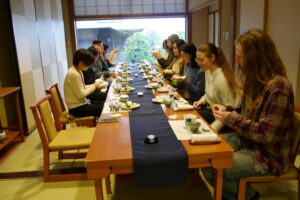
That adjustment crosses cultures. On the monitor tour, Karson Hawkins from Arizona told me that the strongest impression was not an object behind glass but the wagashi he ate in the tearoom and the sense of craft embedded in the space. Jules Coussement from France spoke about the value of hearing the story of Fumai and Kanden-an directly from the head of the Arisawa family. Matsue’s aesthetic begins by sharing silence.
Need to know:
Because of conservation work and seasonal closures, Kanden-an is included only on confirmed opening dates. When it’s closed, we substitute an equivalent module of equal weight.
12:30 Lunch, finished at the table with a pour of dashi
After the tearoom’s restraint, lunch should not be about luxury. It should be about the definition.
Tai-meshi here is compelling because the flavour is not the point. The method is. You build the bowl: warm rice, flaked sea bream, egg, aromatics. Then you pour the dashi to finish it. The taste does not simply arrive in the mouth. It comes in the act of pouring.
Some local accounts link this style of rice, finished with broth and toppings, to the tastes and table culture that developed around Fumai’s world. In Matsue, tea and food share a principle: value is produced by behaviour. Even lunch has choreography. The quiet is in the gesture.
Need to know:
Minami is popular. On the tour, reservations are timed to keep service smooth and unhurried.
14:00 Gessho-ji
With the palate sharpened, you go next to a place that returns time to the air.
Gessho-ji is the family temple of the Matsudaira lords of Matsue. Somewhere on the grounds, you meet Fumai again, not as a historical figure but as a presence whose taste became policy.
To read Gessho-ji properly, borrow another set of eyes: Lafcadio Hearn, known in Japan as Koizumi Yakumo. He arrived in Matsue in 1890 and fell for the city’s unseen register: its hush, its humidity, its stories that sit just beside daily life. Gessho-ji is part of that register.
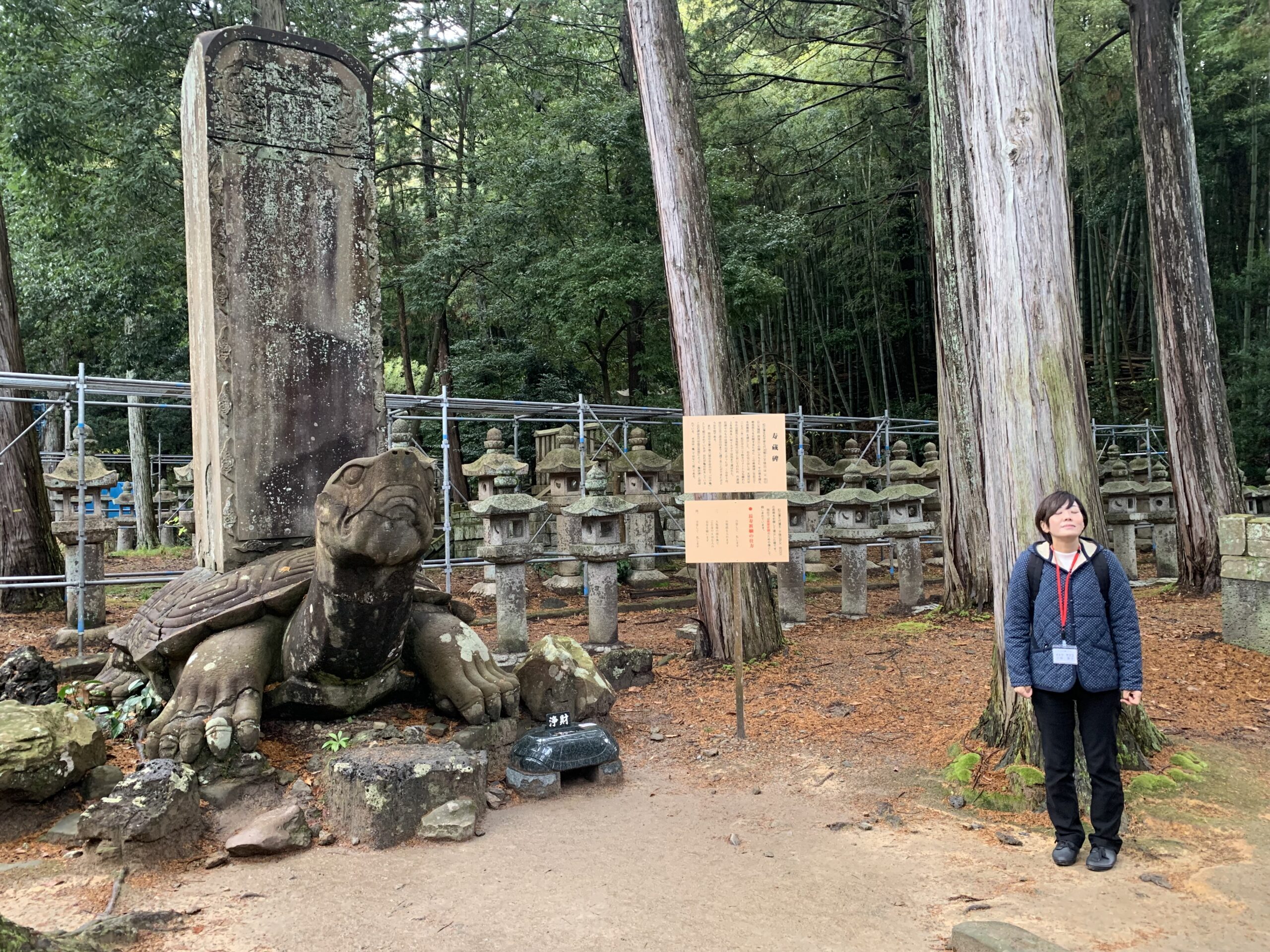
Here you also find the giant tortoise, a monumental stone figure with a legend that Hearn helped popularise beyond the city. In the story, the tortoise rises at night and wanders through the castle town. Matsue does not present the uncanny as spectacle. It keeps it domesticated, placed gently beside moss, shade, and repetition.
Fumai’s aesthetic is often described as subtraction: not silencing everything, but leaving only what matters. Gessho-ji makes that intelligible. It is where the city’s quiet reveals its depth.

Need to know:
Hydrangeas in June, red leaves in autumn. The grounds change by season, and guidance should include timing and where to stand, not only where to walk.
15:30 Abe Eishiro Memorial Hall
The final move is away from the centre and into the satoyama fringe. This stop is not for looking. It is for touch.
Abe Eishiro was a master of Izumo mingei paper and a Living National Treasure. He was closely connected to the thinkers and makers of the Mingei Movement, including Soetsu Yanagi, Shoji Hamada, Kanjiro Kawai, and the British potter Bernard Leach.
Mingei is often translated as folk craft, but it is sharper than nostalgia. It insists that the beauty of a culture is not limited to signed masterpieces. It lives in well-made, everyday tools that are used daily and repaired rather than replaced. The emphasis is not on celebrity but on anonymous skill, repeated until it becomes form.
That philosophy becomes physical here. Once you touch washi, Matsue’s quiet drops from the abstract to the fingertips. Fibres float and shiver in water. A frame lifts the pulp, levels it, and the sheet appears, fragile before it gains strength.
The experience is not limited to papermaking. Fan-making sessions are also offered, using Izumo mingei paper. Ending the day by working with your hands changes what you take home. Matsue’s aesthetic becomes less a memory and more a bodily reference, held in the palms.
Need to know:
Allow extra time for travel; this stop sits on the satoyama fringe. Prices vary by programme and season.
Closing
In six hours, the point is not to see Matsue. It is to learn its ratios: how it builds emptiness, how it completes flavour through action, how it stores time in landscape, and how it turns an idea into texture.
Fumai is the name that connects those elements into a single line. Lower the body at Kanden-an. Complete taste at Minami. Descend into layered time at Gessho-ji. Finish with paper and carry the city out in your hands.
Lower the body, pour the broth, step into the shade, lift the screen. That is Matsue: quiet, practised.
―Words by Takashi Saito.
With reporting support from Urban Goen Travel. Logistics and access were supported; editorial judgement is my own. If you’d rather keep the day clean, Urban Goen Travel can handle reservations end-to-end.