
A note before we begin: this is a longer piece. The terrain is neither simple nor familiar, and it rewards patience.
Visitors to Japan often encounter a phenomenon that quietly defies expectation. A person may visit a Shinto shrine on New Year’s morning, bow with practised grace at a Buddhist temple during the summer Obon festival, and attend a cathedral wedding with no ostensible friction. To a mind forged in the monotheistic fires of the West—where religious identity is often exclusive, doctrinally rigid, and defined by a “jealous” devotion—this fluidity can appear as a philosophical inconsistency, or even a lack of conviction.
It is, in fact, neither. To parse this spiritual landscape, one must look beyond the surface of ritual and examine three distinct apprehensions of the sacred: the Western “God,” the indigenous “Kami,” and the “Buddha.” While these terms are frequently conflated in translation, they represent fundamentally different ways of situating the human experience within the cosmos.
The Etymology of Kami: A Receding Vitality
“Kami” is routinely rendered in English as “god” or “deity,” yet this convenience obscures more than it reveals. The Western image of a deity—a personified, omnipotent being possessed of singular will and moral authority—maps poorly onto the Japanese conceptualisation.
The etymology of the word offers a vital clue. Scholars such as Professor Tomoko Iwasawa have traced “Kami” to two archaic roots: kwamu, a verb meaning “to conceal” or “to recede from view” (sharing a lineage with kuma, a shadow or hidden corner), and i, denoting life-force or animating breath.
What this suggests is profound: Kami does not refer to the mountain as an object, nor to a spirit inhabiting it as a tenant. Rather, it points to the numinous undercurrent of the mountain itself—the charged stillness of its ravines, the uncanny energy pulsing beneath the visible. To perceive Kami is to sense a “shimmering vitality”—an impersonal, dynamic force that animates phenomena rather than governing them from a throne. This explains why Kami are found not only in the sublime features of nature but in the hands of a master craftsman; the sacred is not a matter of personality, but a trembling at the very edge of perception.
Inside the Box and Outside It: A Structural Comparison
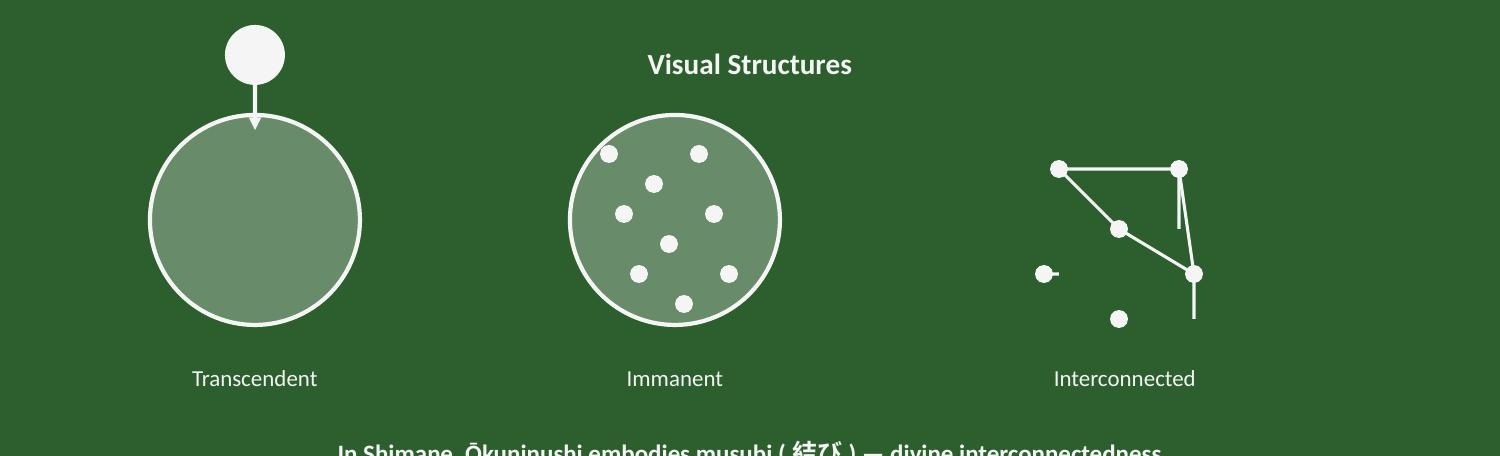
Perhaps the most clarifying way to contrast the Western God with the Japanese Kami is through a spatial metaphor: imagine the universe as a box.
The God of the Abrahamic traditions stands resolutely outside the box. He is the Artifex, the Prime Mover who brought the box into existence ex nihilo—out of nothing. Consequently, the relationship between Creator and creation is one of categorical distinction and vertical authority. While Western philosophy has seen flashes of internalism—most notably in Spinoza’s pantheism, which dared to equate God with Nature (Deus sive Natura)—these have historically been treated as heterodox. The orthodox transcendence of the West remains defined by covenant and commandment; human virtue is a matter of alignment with a divine will that originates from elsewhere.
Kami, by contrast, belongs inside the box. Kami is not the architect of the world but a manifestation of its living fabric. The appropriate human response is not submission or contractual obedience, but a refined attunement: a sensitivity to the invisible web of forces that share our immediate world. Where the Western moral tradition frames virtue as obedience to law, the Japanese tradition frames it as harmony—wa—with the myriad entities that constitute the living whole.
Dependent Origination and the Logic of “Musubi”
When Buddhism arrived in the sixth century, it encountered a spiritual soil remarkably prepared for its seeds. Central to Buddhist ontology is engi (縁起), or dependent origination: the principle that no phenomenon possesses an independent essence, but arises only within an intricate web of causes and conditions.
This relational logic found its mirror in the Shinto concept of musubi (結び). Often reduced in modern parlance to “matchmaking,” musubi denotes the generative power that weaves connections into being. At the Izumo Grand Shrine, the deity Okuninushi is revered not as a judge of souls, but as a facilitator of bonds.
The myth of the “Ceding of the Land,” in which Okuninushi relinquishes his earthly domain to avoid conflict, reflects an ethical priority placed on relational harmony over individual possession. It is a logic that replaces linear causality (A causes B) with a systemic resonance. The sacred, in this view, is concerned less with the exercise of power and more with the maintenance of the connective tissue of reality.
The Logic of Syncretism: Original Ground and Manifest Traces
This shared insistence on immanence—the idea that the divine inheres within the world—is precisely why the fusion of Shinto and Buddhism (shinbutsu-shūgō) occurred so organically. It is an equivalence that reveals much about the Japanese psyche.
The theoretical framework of honji suijaku—”original ground and manifest traces”—proposed that the Kami were local avatars (suijaku) of universal Buddhist deities (honji). Amaterasu, the solar deity, was identified with Dainichi Nyorai, the “Great Sun Buddha.” Crucially, Dainichi Nyorai is not a creator-god; he is the universe itself, the luminous ground of all existence. Even at the apex of its cosmology, the sacred remains inside the box.
The political rupture of the Meiji-era separation of Shinto and Buddhism in 1868 may have uncoupled the institutions, but it failed to sever their experiential connection. To the practitioner, the Buddha’s compassion and the Kami’s vitality are two frequencies of the same atmospheric truth.
Conclusion: Living Within the Web
“God,” “Kami,” and “Buddha” are not merely synonyms for the divine. They represent distinct metaphysical orientations, each carrying its own weight of moral and existential obligation.
What distinguishes the Japanese tradition is its persistent emphasis on interiority—not the interiority of the private soul, but of the world itself. The sacred is not a message sent from a distant shore; it is the tide in which we are already swimming.
The next time you stand in a Japanese sacred space, whether it is the cedar-scented precinct of a forest shrine or the incense-heavy hall of a temple, consider suspending the search for a sovereign deity. You should attend to the quality of the silence and the weight of the air. What you are touching, however obliquely, is a legacy of thousands of years: the recognition of a concealed vitality that pulses beneath the surface, reminding us that we are never standing outside the web of life, but are woven inextricably into its shimmering centre.