
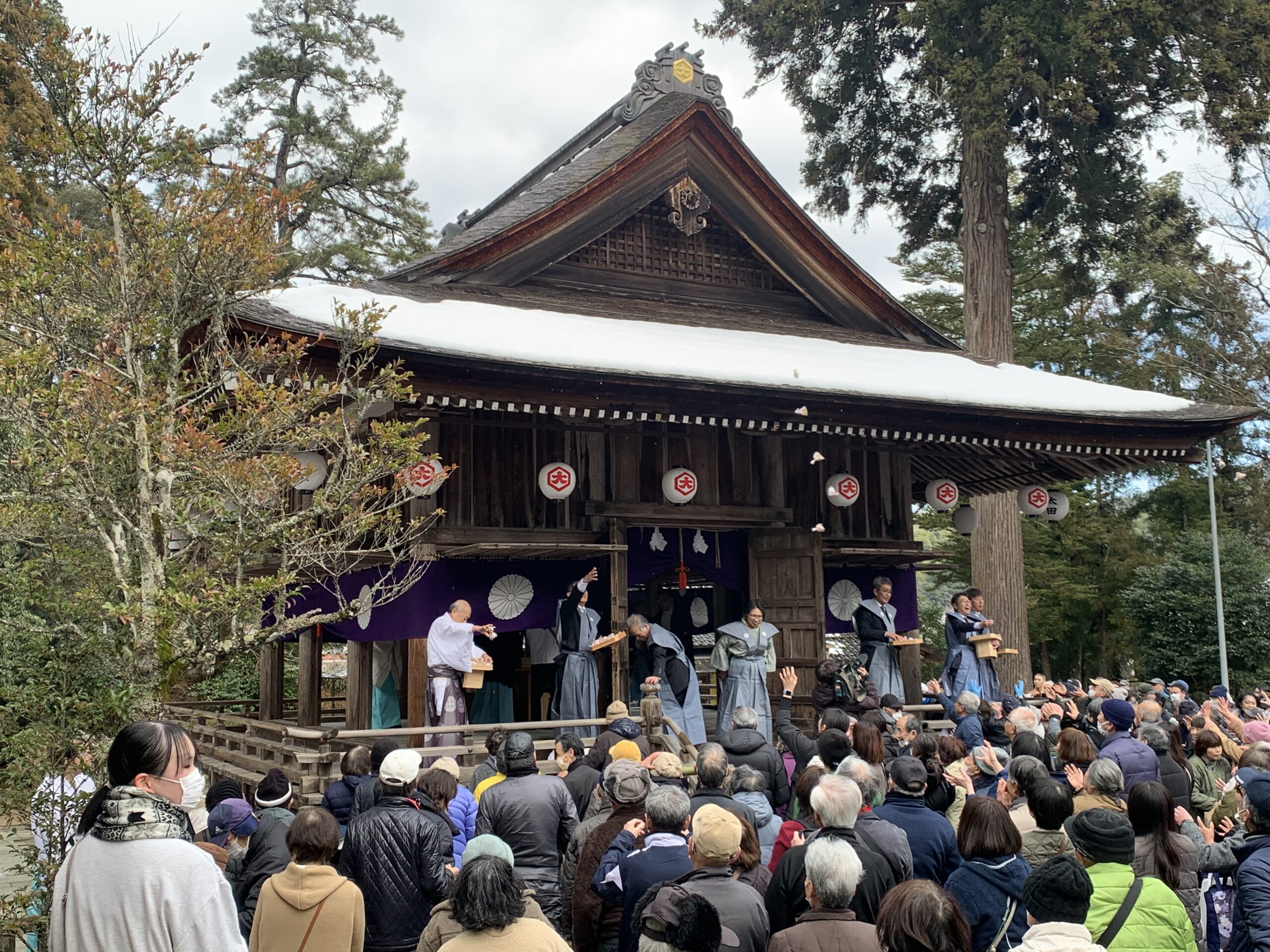
Matsue — As dawn broke over snow-covered Kumano Taisha Shrine on Feb. 3, the morning air was filled with the sounds of shovels scraping against stone paths. Ujiko or Shinto parishioners were preparing for one of the region’s most cherished traditions—and more than 500 visitors would soon arrive to celebrate Setsubun, the traditional bean-throwing festival marking the eve of spring under Japan’s old calendar.
The day’s festivities began at 11 a.m. with Shinto priests conducting rituals to invoke the shrine’s guardian deities, accompanied by the traditional sounds of bamboo flutes and taiko drums. The national anthem was performed as part of prayers for national peace and tranquillity.
The highlight of the festival, the mamemaki bean-throwing ceremony, commenced at 2 p.m. The chief priest ceremonially shot peach wood arrows toward the sky and the earth to signal the start of the event. Shimane Prefecture Governor Tatsuya Maruyama, Matsue Vice Mayor Akihiko Fujiwara, local business leaders, community representatives, and shrine officials then scattered numerous small packets of roasted soybeans to the crowd below.
Attendees eagerly raised their hands to catch the good-luck beans, calling out to the throwers to toss packets in their direction. According to tradition, participants eat the same number of beans as their age to ensure good fortune for the coming year, whilst chanting “Oni wa soto, fuku wa uchi” — “Demons out, good fortune in.”
In the Izumo dialect, mame (beans) also means “healthy” or “vigorous,” adding another layer of meaning to the mamemaki ritual: a wish for everyone’s continued health and vitality throughout the year.
Setsubun customs today also include eating ehomaki rolls whilst facing the year’s lucky direction, which in 2026 is south-southeast. A customary fukubiki raffle was also held, where one lucky participant won the top prize: a kumade (decorative rake) traditionally used to rake in good fortune and prosperity. These ornate bamboo rakes, adorned with auspicious symbols, are popular lucky charms displayed in homes and businesses throughout Japan.
Among those catching the lucky bean packets was Vincent, a visitor from France currently in Japan on a working holiday. His visit to the shrine carried personal significance, as he is scheduled to travel to Ama Town in the Oki Islands the following day to begin a new job.
“I really liked the festival; it’s so interesting that it’s such a typical Japanese tradition,” Vincent said. “I wanted to visit this historic shrine to pray for good fortune before starting my new life and work in Ama. It feels like a very powerful way to begin my journey.”
Setsubun’s roots trace back to ancient Chinese rituals adopted by the Japanese imperial court during the Nara and Heian periods (710–1185). The custom spread to common people during the Muromachi and Edo periods (1336–1868), evolving into today’s blend of tradition and popular entertainment.
Kumano Taisha is located in Yakumo, Matsue. It was once known as Izumo-no-kuni Ichinomiya, the highest-ranking shrine in the Izumo region, and it enshrines Susano-o-no-mikoto, a major deity associated with the Yamata-no-Orochi legend. The shrine is also recorded in the eighth-century chronicle Izumo no Kuni Fudoki.
The shrine is nationally known for its annual Kamedayuu ritual on October 15, where the chief priest of Izumo Grand Shrine visits to request sacred fire-starting tools in a unique ceremony that blends solemnity with comedy.
The shrine can be reached from Matsue Station in about 45 minutes by bus with a transfer, getting off at Kumano Taisha-mae. Free parking is available for around 100 vehicles.
From Tokyo, travellers can reach Matsue by taking the Shinkansen and transferring at Okayama to the Limited Express Yakumo, or by using the overnight Sunrise Izumo sleeper train. Another option is to fly from Haneda to Izumo Airport (approx. 75 minutes) before continuing by local transport.
Words by Takashi Saito
Access Information Table
| Transportation Method | Details |
|---|---|
| Air | Approx. 75 minutes flight (Haneda to Izumo), then local transport |
| Shinkansen & Limited Express | Via Okayama, transferring to Limited Express Yakumo |
| Overnight Train | Sunrise Izumo sleeper train |
| Local Bus | About 45 minutes from Matsue Station with a transfer to Kumano Taisha-mae |
| Parking | Free parking for approximately 100 vehicles |