
On the third day of each year, a fishing village on Japan’s Sea of Japan coast draws a line around itself. The ritual is 250 years old. The question is what, exactly, it outlines.
The wind arrives from Siberia in a straight line, turning cheeks numb and making rope creak at its knots. On the Shimane Peninsula, winter is not a backdrop but a presence—something you move through, adjust to, work against. The third of January is no exception. If anything, the cold sharpens what happens that day.
This is Etomo, a fishing village whose name appears in records dating back to 733. The Izumo no Kuni Fudoki preserves a deity’s remark: “This place is youthful and beautiful; the shape of the country is like a picture.” From central Matsue, it is close enough to reach without fuss: hire a car near Matsue Station, or take a local bus if you are willing to work around a less frequent service. The word “shape” matters here. Etomo has always been less about scale than outline—about where land ends, water begins, and a community agrees to meet.
For centuries, that agreement was built on fish. In the late eighteenth century, the Matsue domain dug a canal linking Lake Shinji to the sea, and Etomo became a working hinge for large set nets, offshore trawling, and squid fishing. Boats departing before five in the evening, returning in the small hours. By the post-war era, the harbour was full.
There was another workforce, too: Kankan butai, or the Kankan squad, fishermen’s wives who became fish traders. They carried aluminium cases to market at first light, bought stock, then rode a dedicated bus into the city to sell door to door. It was an economy built on stamina and an instinct for which streets would buy what on which day. In winter, the fish arrived cold enough to burn the fingers through cloth.
Now, only a handful of boats remain. The kankan butai is gone. The harbour’s stillness conveys the scale of change better than any statistics. You hear it in the gaps: the absence of shouted timings, the lack of tyre tracks by the sheds, the way the gulls seem louder than they should.
But once a year, on 3 January, something returns.
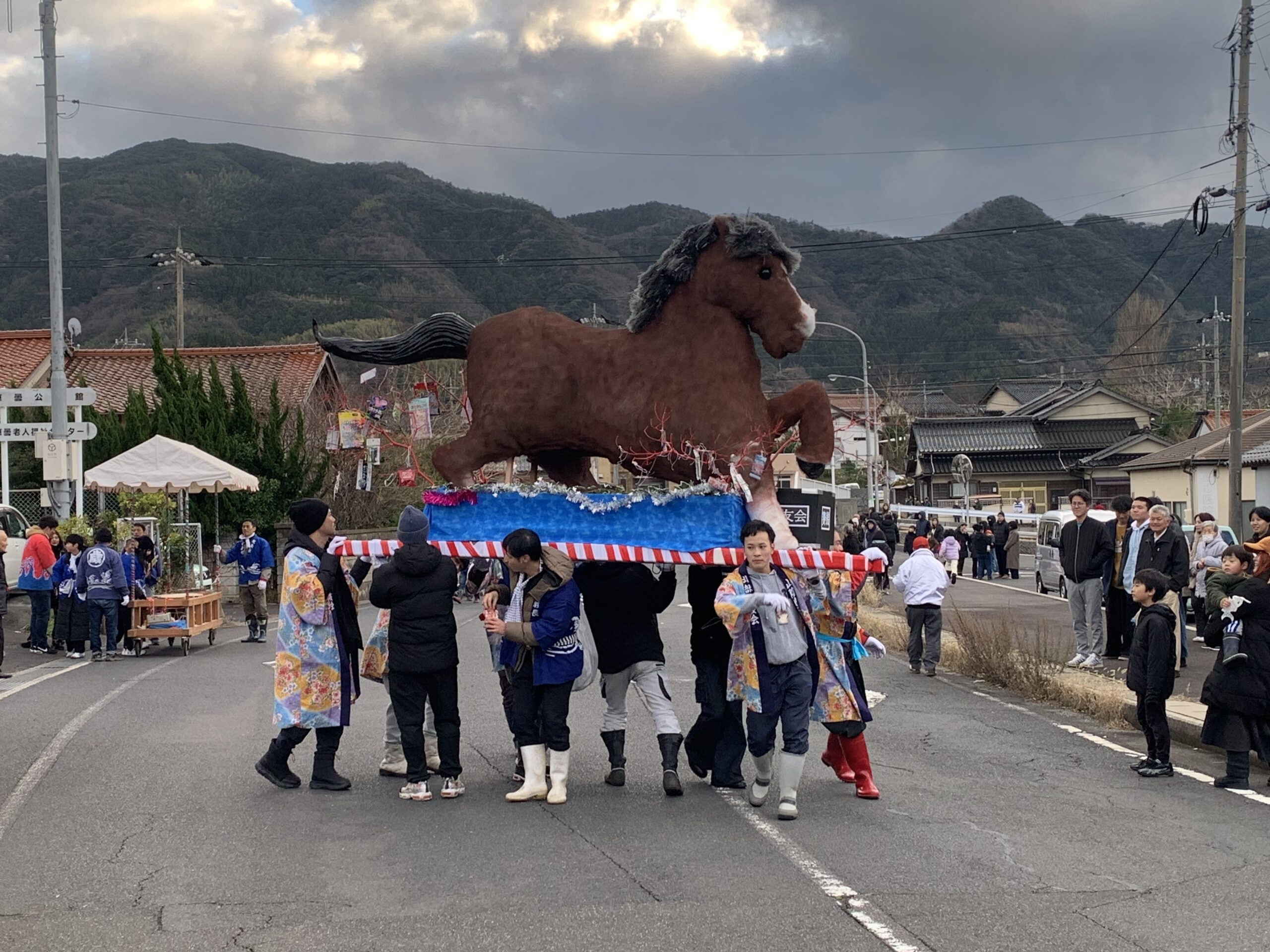
The ritual is called Sagichō. It begins with a plaque bearing the name of Toshitokujin, the deity of the year. Children pull a treasure-boat float. The rhythm comes from taiko drums and bamboo flutes: a deep, chest-level beat and a bright, reedy reply. At the centre of Etomo’s procession are two portable shrines: one carried by adults and the other by children, both marked with this year’s zodiac animal, the horse.
Across the water, the neighbouring village of Koura stages its own procession with one portable shrine and its own boat float. The three meet on the Minato Bridge. There, the shrines clash—carriers braced, feet sliding, breath visible in the cold. Older residents recall when this moment, fuelled by sake, would tip into fights. Now it is calm, almost procedural. The carriers pause, exchange glances, and give a slight nod. It feels less like competition than confirmation.

After the clash, the crowd disperses. One festival coat after another is swallowed by dusk. Within an hour, the town is silent again, as if the sound has been folded and put away.
On the harbour edge, a man lights a cigarette, cupping his hands against the wind. The flame flickers, holds, steadies. Behind him, someone secures a tarpaulin on one of the few remaining boats: pull, knot, check; pull, knot, check. These small maintenance tasks, repeated year after year, keep the outline visible.
The ancient text spoke of a shape made orderly. That shape now exists in the ritual itself—the gathering, the drums, the chant, the nod on the bridge. It is the short, bright interval when the town is loud enough to recognise itself. Not preservation, but an annual re-drawing of the line.
Silence can be a virtue. It can also look like a blank space. Perhaps the difference lies in whether anyone returns to walk the perimeter. In Etomo, for now, someone does.
The question is not whether the town will survive in its former form. It will not. The question is whether the outline—drawn and redrawn each year—still holds meaning for those who walk it. For the man lighting his cigarette in the wind, for the person knotting rope in the fading light, the answer seems to be yes.
The wind picks up—the flame steadies. The line holds.
— Words by Takashi Saito
How to reach Etomo
From Tokyo, Matsue is reachable by rail in a single, clean sequence: take the shinkansen to Okayama, then change for the Limited Express Yakumo to Matsue. The whole journey is typically just under seven hours, depending on connections.
Flying is quicker. Direct flights run from Tokyo Haneda to Izumo Enmusubi Airport in around 1 hour 20–30 minutes. From the airport, shuttle buses meet arrivals and reach Matsue Station in roughly 30–35 minutes.
From Matsue, Etomo is close. Local buses run from Matsue Station to Etomo, though service is infrequent—checking the timetable in advance is wise. By car, the drive takes around 30 minutes from central Matsue, and hiring a car near Matsue Station is a straightforward option if you want flexibility.