
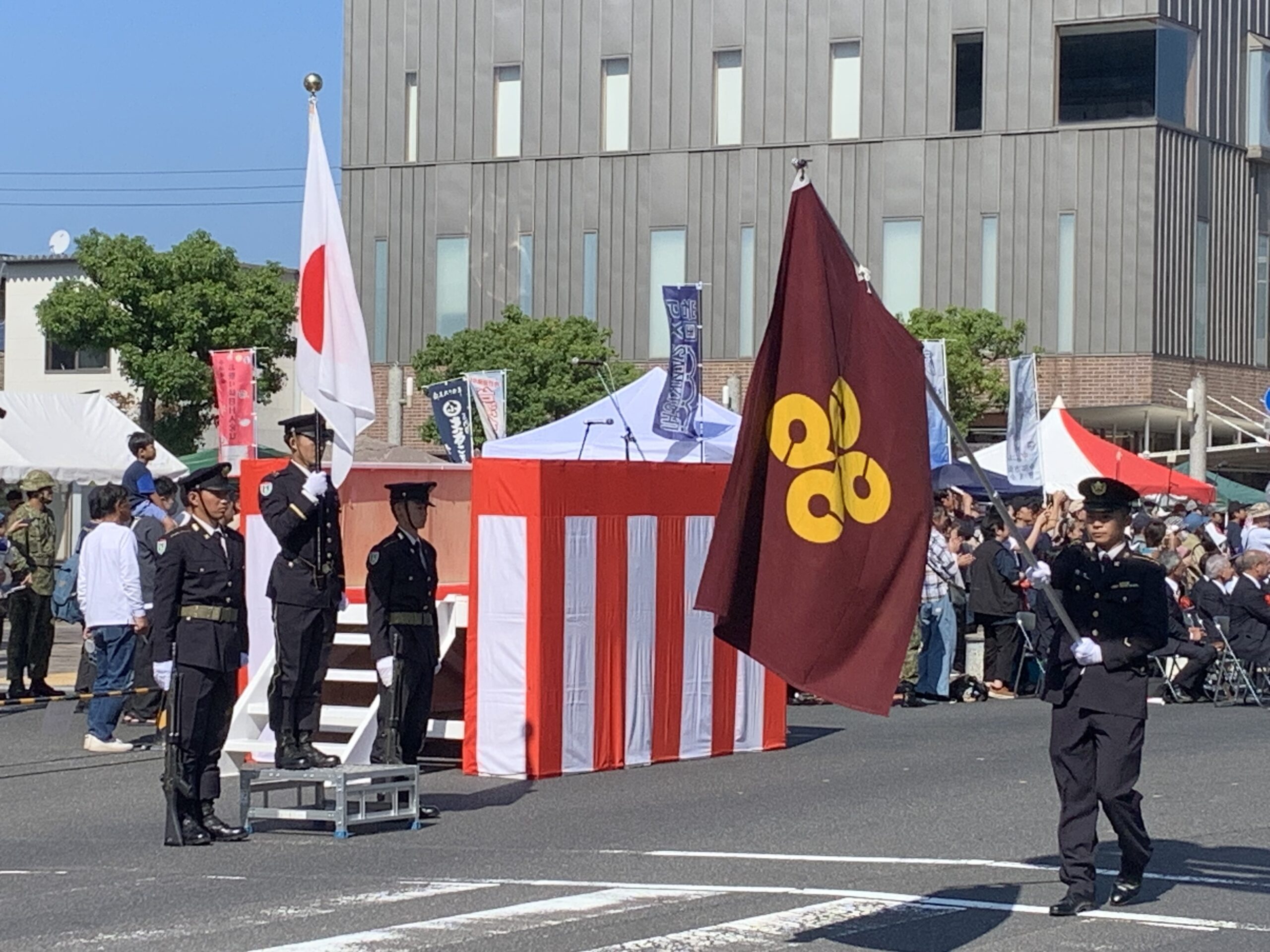
Izumo, a coastal city in Shimane Prefecture about 630 kilometres west of Tokyo and best known as home of Izumo Taisha Grand Shrine, hosted a ceremony and parade on 11 October, as the Japan Ground Self-Defense Force (JGSDF) Izumo Garrison marked its 72nd anniversary.
Under crisp autumn skies, troops from the garrison marched along Kunibiki Central Street — a roughly 400-metre stretch from JR Izumo Station to Izumo City Hall — as spectators waving national flags lined the route.
Troops from JGSDF Izumo Garrison march through Kunibiki Central Street.
The military parade featured about 120 personnel and 43 vehicles, including several domestically produced Type 16 Manoeuvre Combat Vehicles. Around 2,000 spectators, including lawmakers and local officials, gathered to celebrate.
Japan’s Self-Defense Forces were created within the framework of the nation’s postwar pacifist constitution and operate under a strictly defence-oriented policy. Japan has renounced war, as well as the threat or use of force, as a means of settling international disputes. Under this doctrine, the SDF is limited to a minimum necessary use of force for self-defence, rather than a presence abroad.
The Izumo ceremony opened with a performance by the JGSDF 13th Band, followed by a display from the Takaoyama Red Club, a local bicycle display team inspired by the Air Self-Defense Force (JASDF)’s aerobatic squadron Blue Impulse. Formed by volunteers from the Takaoyama Sub Base, which operates the JASDF radar site in Mihonoseki on the Shimane Peninsula, the team performs at community events across the region. Its name, Red Club, means “Red Crab” — referring to the prized snow crab caught in nearby coastal waters.
The JASDF cycling team, Takaoyama Red Club, performs its formation display.
Lt. Col. Daisuke Komatsu, commander of the 13th Reconnaissance and Combat Battalion and of the JGSDF Izumo Garrison, quoted the Self-Defense Forces’ service oath:
“Thanks to support from the citizens of Izumo and the people of Shimane Prefecture, we are able to conduct this parade in the heart of the city,” he said.
“In an increasingly complex and severe international environment, we will respond promptly and decisively as the first force in times of disaster, and when duty calls we will fulfil our missions without hesitation, even risking our own safety.”
Former Maritime Self-Defense Force officer and current member of the House of Representatives Yasuhiro Takami encouraged the troops by recalling his years of service.
“Whenever your missions feel difficult, I hope you will remember this scene,” he said.
The marching column included flags from each municipality in Shimane Prefecture, followed by a convoy of GSDF vehicles. Among them, a vehicle driven by a female GSDF member drew particular attention, highlighting the growing role of women within Japan’s Self-Defense Forces. It was one of the few occasions in Japan when the garrison’s vehicles conducted a parade through the city centre, reflecting growing public interest in the Self-Defense Forces. The parade concluded with a flyover by a UH-1J helicopter, drawing cheers from spectators.
A Type 16 Manoeuvre Combat Vehicle (MCV).
Luiz Carlos dos Santos, a former Brazilian police officer who now runs a steakhouse in Izumo, said he was impressed by the parade’s precision and discipline.
“It was perfectly organised — beautiful to watch,” he said.
Established in 1953, the Izumo Garrison has expanded its personnel in line with Japan’s evolving security environment. Following the establishment of the 13th Reconnaissance and Combat Battalion in March 2024, the number of vehicles at the base doubled from about 50 to around 100, and personnel increased from some 350 to about 530, prompting the Ministry of Defense to move ahead with a modest expansion of the compound by acquiring neighbouring land.
The 13th Reconnaissance and Combat Battalion conducts intelligence and surveillance missions while also maintaining combat readiness. The unit participated in the Japan-U.S.-Australia joint military exercise Southern Jackaroo, held from May to June this year.
The battalion is under the command of the JGSDF 13th Brigade, headquartered at Camp Kaitaichi in Hiroshima Prefecture, and is responsible for defence and disaster relief operations covering the five prefectures of Yamaguchi, Hiroshima, Okayama, Tottori and Shimane.
The garrison, overlooking the Sea of Japan, plays a vital role in both national defence and disaster-response operations. Viewed from the Asian mainland rather than from Tokyo, Izumo sits on the outer edge of the Sea of Japan coastline, making this quiet region a potentially crucial area in the country’s security and disaster-response framework.
Japan’s overall security environment has undergone significant changes in recent years. North Korea’s missile launches and China’s maritime activities around the Taiwan Strait and the South China Sea have heightened tensions in the region. In response to these shifts, Tokyo has updated its key national security documents and has laid out plans to substantially increase defence spending over the coming decade. At the same time, Japan has strengthened cooperation with its ally, the United States, and with Australia as an important security partner, while reinforcing its domestic readiness for contingencies and natural disasters through expanded personnel and upgraded equipment.
The event reflected the close bond between the JGSDF and local community. Families with children lined the streets, many expressing surprise at the size of the vehicles — a rare sight that underscored their connection with the troops.
The anniversary ceremony and parade, now in its 19th year, embodied the discipline of the Self-Defense Forces and also the quiet pride shared between the garrison and people it protects. In Izumo, national defence begins with a bond of trust between the uniformed and ununiformed.
ーWords by Takashi Saito
Caption: The Shimane Prefecture flag, borne by the colour guard, passes before the national flag.